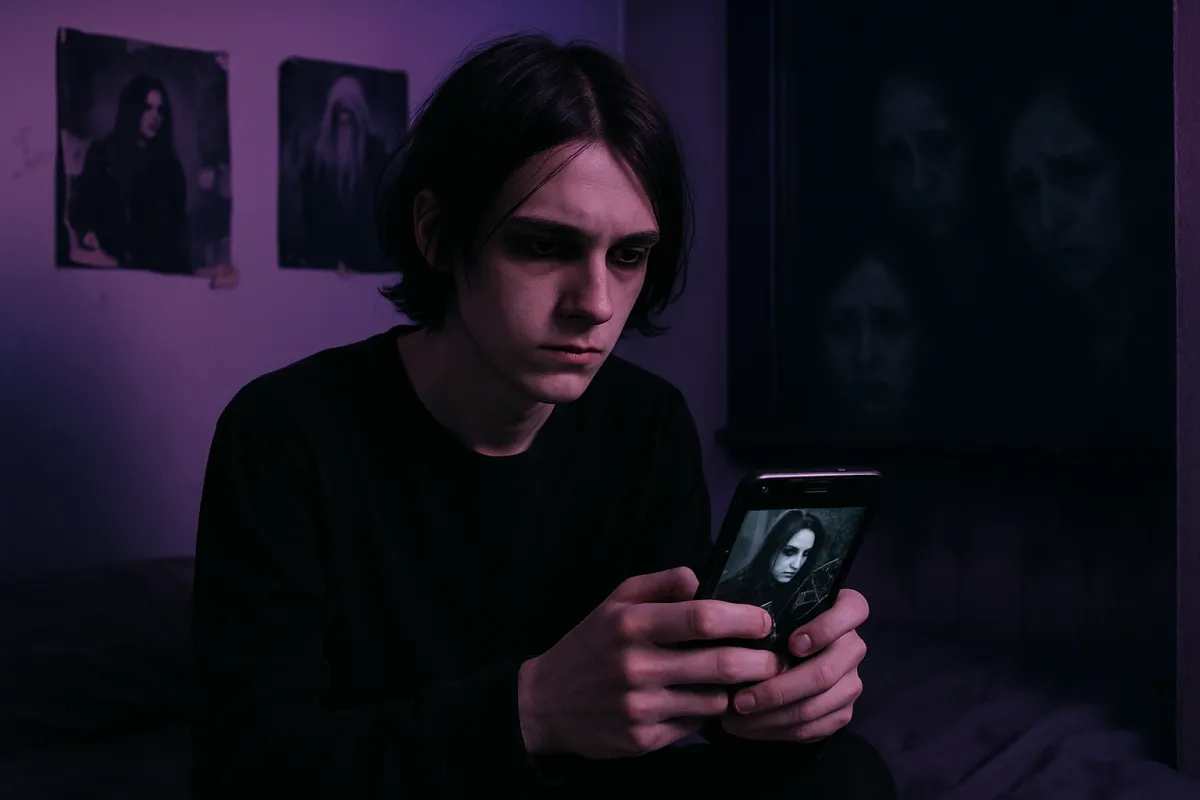
If your feed has been flooded with gothic memes, dark humor, and posts about being “dead inside,” you’re not alone. A recent viral collection titled “The Mememare”: 134 Goth Memes For Anyone Who Doesn’t Fit In on Bored Panda struck a nerve across social media, tapping into something deeper than aesthetics: a generation using dark comedy and goth culture to cope with anxiety, loneliness, and emotional burnout.
Psychologists have long discussed the idea of the “shadow self” — the parts of our personality we hide or suppress. Today, that shadow is being expressed not only in therapy rooms, but in memes, fandoms, and subcultures that normalize talking about pain through irony and humor. The rise of goth memes is not just an online trend; it’s a real-time snapshot of how people are trying to regulate their emotions, find belonging, and stay afloat mentally in a relentlessly stressful world.
This isn’t inherently bad — in many cases, it’s adaptive. But relying only on humor and aesthetics without deeper support can leave people stuck. Below, we unpack what this trend tells us about our collective mental health right now, and outline evidence-based strategies to move from “relatable misery” to genuine resilience.
1. From “Shadow Self” to Shared Feed: Why Dark Humor Feels So Comforting
The Bored Panda feature on “The Mememare” frames goth memes as a playful expression of the “shadow self.” That term, popularized by Swiss psychiatrist Carl Jung, refers to the emotions and traits we’re taught to hide — anger, despair, envy, fear, and vulnerability.
What’s new is the scale and speed at which these shadows are being broadcast. Instead of journaling in private, millions of people are posting “I’m not okay” jokes in public, softened by humor and gothic aesthetics. Research on dark humor suggests that for many, this can be a healthy coping strategy: studies have found that people who appreciate dark humor often show greater emotional control and lower aggression, because they’re processing distressing material in a symbolic, less threatening way.
However, context matters. When dark humor is paired with chronic isolation, untreated depression, or substance use, it can function more as emotional numbing than healthy processing. The key distinction: after engaging with this content, do you feel slightly lighter and more connected, or more hopeless and stuck? If it’s the latter, it’s a signal that meme-based coping isn’t enough on its own.
A more sustainable approach is to see goth memes and dark humor as gateways — an entry point to recognize your pain, name it, and then support it with practices shown to improve mood and mental health over time.
2. Turning “I Don’t Fit In” Into a Mental Health Asset
The viral goth meme collection is explicitly for “anyone who doesn’t fit in.” Feeling like an outsider is one of the most common psychological pain points today; surveys from multiple countries consistently report rising rates of loneliness, especially among younger adults and heavy social media users.
Paradoxically, goth culture and dark memes can turn that alienation into belonging. When you see a post that mirrors your internal monologue — your social anxiety, your insomnia, your existential dread — the instant reaction is often relief: “So it’s not just me.” That moment of recognition, called social mirroring in psychology, is powerful. It reduces shame and can be a first step toward seeking help.
The risk is stopping there. Consuming endless content about not fitting in can cement an identity of permanent “otherness,” which is strongly linked with persistent depressive symptoms and self-stigma. The most resilient communities, including long-standing alternative subcultures like goth and punk, tend to combine shared aesthetic and dark humor with active forms of connection: meetups, creative projects, and mutual support.
To use this trend in a mentally healthy way, the goal is to move from passive scrolling to active connection: using that sense of “these are my people” as a springboard into real relationships and supportive practices — online or offline.
3. When Memes Aren’t Enough: Reading the Red Flags in Dark Humor
One subtle danger of a feed full of self-deprecating, goth-style jokes is normalization. If every other post collapses serious distress into a punchline, it becomes harder to recognize when someone — or you — is actually in trouble.
Research on suicide prevention and depression highlights a cluster of warning signs that can sometimes hide beneath humor:
- Jokes that move from general “life is meaningless” themes to very specific references to self-harm, death, or “not being around much longer”
- A noticeable increase in isolation offline, even if online posting continues
- Loss of interest in things that used to matter, including creative or subcultural interests
- Significant changes in sleep, appetite, or energy beneath the jokes
- Expressions of being a burden, useless, or irredeemably broken
If you recognize this pattern in yourself, treating it as “just my sense of humor” can delay getting help. If you notice it in someone else, silence can be dangerous.
A better approach is direct but compassionate curiosity, backed by evidence from mental health interventions: ask clear, open questions (“You joke about not wanting to be here — are you actually feeling that way?”), validate their feelings (“That sounds incredibly heavy”), and encourage professional support (“You don’t have to carry all of that alone; would you be open to talking to someone trained to help?”). This combination — directness, validation, and practical guidance — aligns with best-practice communication in suicide prevention.
4. Evidence-Based Wellness Practices That Go Deeper Than a Relatable Post
Goth memes and dark humor can be part of a modern emotional toolkit, but they’re not a standalone mental health strategy. Decades of research point to a set of core practices that reliably support mood, resilience, and cognitive health across cultures and age groups. Here are five that integrate well with a digitally immersed, subculture-savvy lifestyle.
a. Structured Emotional Expression (Beyond Jokes)
Memes are micro-expressions of emotion; they rarely capture the full complexity of what you’re going through. Structured emotional expression — like expressive writing — has strong empirical support. Studies have shown that spending 15–20 minutes on several days writing about your deepest thoughts and feelings around stressful events can reduce symptoms of depression and anxiety, improve immune function, and even support better sleep.
How to apply it:
- Set a timer for 10–20 minutes, three times a week.
- Write freely about what you’re actually feeling — anger, fear, grief, numbness — without trying to be funny or polished.
- Don’t worry about grammar or style; this is for you, not for posting.
- Afterward, do something soothing (music, stretching, a warm drink) to help your body downshift from emotional activation.
This doesn’t mean abandoning humor. It means balancing it with spaces where you can be unfiltered, honest, and uncool.
b. Behavioral Activation: Doing Before You Feel Like It
Depression and burnout often come with the conviction that you should wait to “feel motivated” before doing anything. Behavioral activation, a well-validated therapy approach, flips that: you schedule and complete meaningful activities first, trusting that mood will often follow action, not the other way around.
Evidence shows behavioral activation can be as effective as cognitive therapy for many people with depression. It works by breaking the cycle of avoidance and withdrawal that fuels low mood.
How to apply it:
- Make a short list of activities that used to give you even mild satisfaction: sketching, putting on makeup, gaming with a friend, walking at night with music, attending a local show.
- Schedule one small activity per day, even if your brain tells you it’s “pointless.”
- Start with extremely low thresholds (“draw for 5 minutes,” “walk to the end of the block,” “send one message to a friend”).
- Track your mood before and after; often, slight mood lifts accumulate over time.
Goth or alternative aesthetics can actually make this easier: styling an outfit, curating a playlist, or working on art all count as structured, rewarding behaviors.
c. Sleep Hygiene Tailored to a Night-Oriented Life
Many people drawn to goth culture or heavy online engagement are night owls by preference or necessity. Unfortunately, irregular sleep and excessive blue light exposure are strongly linked to increased anxiety, depression, and emotional volatility.
The solution is not forcing a 5 a.m. wake-up if that’s incompatible with your life; it’s improving sleep quality and regularity within your natural rhythm.
Evidence-based strategies:
- Keep your sleep and wake times as consistent as possible, even if shifted later.
- Use blue light filters or glasses in the late evening and dim your environment progressively.
- Avoid heavy scrolling in bed; if you need your phone, switch to audio (podcasts, music) rather than endless visual input.
- Anchor your “morning” (whenever it is) with light exposure and movement to stabilize your circadian rhythm.
Consistent, high-quality sleep underpins emotional regulation, making you less dependent on humor as your only defense against irritability and hopelessness.
d. Deliberate Social Micro-Connections
The goth meme article reflects a digital crowd of people who “don’t fit in,” but many of them are still profoundly lonely. Research on social connection shows that even brief, low-intensity interactions — what psychologists call weak ties — can significantly improve mood and reduce feelings of isolation.
How to apply it in a way that respects your temperament:
- Instead of broadcasting to hundreds, choose 1–3 people you trust and send them an honest check-in, not just a meme.
- Join smaller, moderated online communities or servers where in-depth conversation is encouraged.
- If you go to shows, meetups, or local events, aim for one micro-connection: a short conversation, a compliment, a shared joke.
- Use your interests (music, art, fashion) as social bridges — research shows common identity is a powerful protective factor for mental health.
Connection doesn’t require becoming an extrovert. It requires intention: choosing a few genuine points of contact rather than relying solely on likes and shares as your emotional lifeline.
e. Evidence-Based Self-Compassion, Not Just Self-Irony
Dark humor often targets the self: calling yourself broken, useless, or unlovable in exaggerated terms. In moderation, this can be bonding; in excess, it reinforces deeply negative self-schemas that keep depression and anxiety alive.
Self-compassion, as studied by psychologist Kristin Neff and others, is not self-indulgence. It’s a disciplined practice of responding to your own suffering with the same realism, kindness, and perspective you’d offer a close friend. Meta-analyses show that higher self-compassion is linked to lower depression, anxiety, and stress, and better overall life satisfaction.
Practical steps:
- Notice when a self-insulting meme or thought arises and mentally add: “I’m joking, but a real part of me is hurting.”
- Reframe that hurt with three elements:
- Mindfulness: “I’m feeling really overwhelmed and lonely right now.”
- Common humanity: “A lot of people feel this way, especially in times like these.”
- Kindness: “I deserve support and care while I’m going through this.”
- Experiment with posting or journaling one self-compassionate statement for every few self-deprecating jokes you make.
This doesn’t mean abandoning your sense of humor; it means refusing to make cruelty toward yourself the default punchline.
5. When to Move From Memes to Professional Help
The current wave of goth and dark-humor content reflects a world where traditional support systems feel shaky and many people are turning to the internet as their primary coping space. But there are limits to what any subculture or social platform can provide.
International clinical guidelines suggest reaching out for professional support when:
- Your mood is persistently low, irritable, or numb for more than two weeks
- You’ve lost interest in almost all activities, even the ones that used to comfort you
- Your sleep, appetite, or concentration are significantly disrupted
- You’re using substances or self-harm to manage emotions
- You experience recurring thoughts that life isn’t worth living, or that others would be better off without you
Professional help does not erase your identity, aesthetics, or sense of humor. A good clinician will work with — not against — the ways you naturally understand and express your inner world, including goth culture or dark humor. Modalities like cognitive-behavioral therapy (CBT), dialectical behavior therapy (DBT), and acceptance and commitment therapy (ACT) all have strong evidence bases and can be adapted to your values and style.
If immediate safety is a concern — for you or someone you know — crisis hotlines, text services, and local emergency services exist for that reason. Reaching out is not a betrayal of your persona; it’s a signal that you’re taking your pain seriously enough to deserve real support.
Conclusion
The viral success of “The Mememare” goth memes isn’t just another content cycle; it’s a cultural signal. Millions of people are using dark aesthetics and humor to articulate what clinical language often misses: feeling alienated, exhausted, and emotionally underwater in a world that won’t slow down.
Honoring that reality means going beyond simply sharing another “I’m not okay” joke. It means pairing the relief and solidarity of dark humor with evidence-based practices — structured emotional expression, behavioral activation, sleep optimization, deliberate micro-connections, and self-compassion — that actually move the needle on mental health.
You don’t need to abandon your shadow self to heal. You need places where that shadow is seen, understood, and supported with tools that work. The memes can stay. But they don’t have to be the whole story.
Key Takeaway
The most important thing to remember from this article is that this information can change how you think about Mental Health.